
Temple of Athena Nike ✨
The smallest temple on the Acropolis, dedicated to Athena as goddess of victory. This is where ancient Athenians prayed for success before battle and gave thanks when they returned.
What is the Temple of Athena Nike?
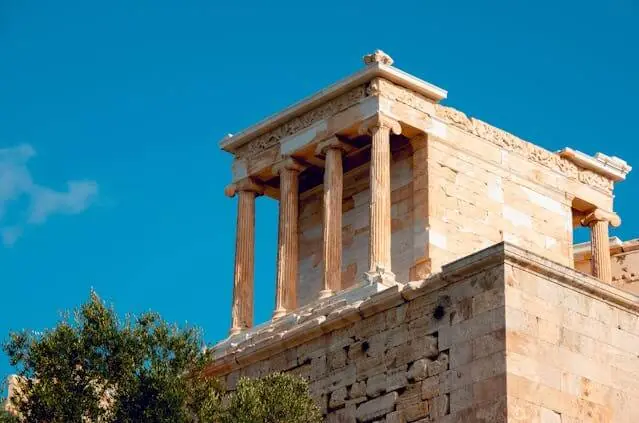
The Temple of Athena Nike is an ancient Greek sanctuary located on the southwest corner of the Acropolis, perched atop a steep bastion and dedicated to Athena in her role as goddess of victory. Built from about 427 BCE and completed by about 420 BCE, this Ionic temple greeted every visitor ascending to the Acropolis - positioned so that victory would bless all who entered.
Despite its small size - just 8 meters long and 5.5 meters wide - the temple stands out through its refined design. Architect Kallikrates created a compact building constructed from white Pentelic marble, featuring monolithic columns and detailed friezes that demonstrate Greek craftsmanship at its best.
The temple once housed a wooden cult statue of Athena depicted without wings. Ancient Athenians called her Athena Apteros (“wingless”), believing that by removing her wings, victory could never fly away from their city.
Book the best Acropolis ticket
Acropolis & Parthenon Tickets with Optional Audio Guide
Skip the ticket lines and step into ancient history at your own pace. Explore the iconic Parthenon, Temple of Athena Nike, and Theatre of Dionysus with a multilingual audio guide that reveals the myths, legends, and stories behind Athens' most treasured monuments.
Includes:
- Timed entry to the Acropolis
- Audio guide in English, French, German, Spanish & Italian
- Offline audio guide and map on your phone
Best price starting at:
39 €
Acropolis & Parthenon Guided Tours with Entry Tickets
Explore the Acropolis with an expert guide who brings ancient history to life. Small groups, headsets for clear audio, and plenty of time for questions and photos. Enhance your visit with optional add-ons like the Acropolis Museum, Ancient Agora, or a walk through Plaka.
Includes:
- Guided tour of the Acropolis & Parthenon
- Skip-the-line entry
- Guide in English, Spanish, French, German, or Italian
Best price starting at:
34 €
Combo: Acropolis & Parthenon + Acropolis Museum Tickets
One plan, two iconic sites. Walk through the Acropolis hilltop monuments with reserved timed entry, then explore the Acropolis Museum, all connected by multilingual audio guides on your phone with offline maps, narration, and interactive content.
Includes:
- Time-slotted e-ticket to the Acropolis & Parthenon
- Entry ticket to the Acropolis Museum
- Audio guide in English, German, French, Spanish, Italian & Greek
Best price starting at:
75 €
The story of the Temple of Athena Nike
Earlier shrine on this site
A small shrine honoring Athena Nike existed here as early as the 6th century BCE, where Athenians sought the goddess’s blessing before military campaigns. Today, visitors with an Acropolis ticket can stand where ancient Athenians once prayed for victory. Archaeological evidence shows that the site was used for religious rituals during the Mycenaean era, with the Mycenaean bastion forming the fortified base for later temples. In the 6th century BCE the cult image of the goddess stood on a simple limestone base.
Construction
After the Persian defeat, Athenian leader Pericles commissioned a rebuilding of the Acropolis. The Temple of Athena Nike was part of this program, though construction didn’t begin until around 427 BCE - after Pericles’s death. Kallikrates, who had co-designed the Parthenon, received the commission.
The timing was significant. Athens was fighting the Peloponnesian War against Sparta, and a temple celebrating victory served both religious and political purposes. The temple was completed by about 420 BCE.
Later history
Like its larger neighbors, the temple went through major changes. In the Christian era, the Temple of Athena Nike was reportedly used as a church. In 1686, Ottoman forces completely dismantled the entire structure to build gun fortifications - the temple’s stones became defensive walls.
After Greek independence, archaeologists recovered the scattered blocks and reconstructed the temple in 1834. Further restorations followed in the 1930s, and a comprehensive conservation project was completed in 2010.
Architecture of the Temple of Athena Nike
Ionic style
While the Parthenon is Doric, the Temple of Athena Nike is Ionic - a more decorative style with slender columns. The temple is amphiprostyle: it has four monolithic Ionic columns at the front and four at the back, but no columns along the sides. Typical Ionic features such as the volute capitals complete its elegant appearance.
The proportions were calculated to complement rather than compete with the massive Doric Propylaea nearby. The contrast was intentional.
Dimensions
The temple measures approximately 8 meters long, 5.5 meters wide, and 7 meters high. It's the smallest temple on the Acropolis, but its elevated position on the bastion made it visible from across Athens. Visitors approaching the Acropolis would have seen it silhouetted against the sky.
The interior
The temple’s inner chamber housed the cult statue of Athena Nike. The wooden figure has long since disappeared, but ancient sources describe a goddess holding a pomegranate (symbol of fertility) in her right hand and a helmet in her left. Unlike typical Nike representations, this statue had no wings.
Sculptural program
The Friezes
A continuous Ionic frieze wrapped around the temple exterior, with different scenes on each side.
The reliefs are carved in the idealized classical style of the 5th century BCE and combine scenes from the world of the gods with battles from Athenian history.
The east frieze showed an assembly of Olympian gods, with Athena among Zeus, Poseidon, and other deities. The south frieze depicted the Greek victory over the Persians at Plataea in 479 BCE. The north frieze showed cavalry battles, possibly referencing conflicts with neighboring city-states.
The Parapet
Around 410 BCE, a marble parapet was added around the bastion as a safety barrier. The parapet features relief sculptures of Nike in various poses, celebrating victory and sacrifice - leading sacrificial bulls, erecting trophies, adjusting their sandals.
The temple itself was crowned by akroteria, sculptures on the corners and ridge of its roof. The central figures may have represented flying Nikes or other symbols of victory.
Nike Adjusting Her Sandal
One relief became particularly famous: Nike loosening or removing her sandal. Her transparent drapery clings to her body, demonstrating the sculptor’s skill with fabric in stone.
The relief may reference the custom of removing shoes before entering sacred space. The original is now in the Acropolis Museum, where visitors can see details that aren’t visible at the original height.
Athena Nike: The goddess of victory
Different aspects of Athena
Athena had many titles reflecting different roles. The goddess Athena, one of the Olympian gods, was central to Greek mythology as a symbol of wisdom, warfare, and the protection of cities. As Athena Parthenos, she was the virgin protector of Athens. As Athena Promachos, she led warriors into battle. As Athena Ergane, she patronized craftspeople.
As Athena Nike, she embodied victory - not just military conquest but success in athletics, legal disputes, political debates, and other competitions. The sanctuary of Athena Nike was also notable as the site of the first democratic priesthood in Athens, where the priestess was chosen by lot from among all Athenian women.
Nike as a separate goddess
Nike existed independently as a goddess personifying victory. In Greek mythology and art, she is often referred to as ‘winged victory,’ symbolizing the personification of triumph. Artists typically depicted her as a winged woman capable of flying to wherever victory was needed. Her most famous representation shows her landing on a ship’s prow with wings spread.
In the Temple of Athena Nike, however, the statue had no wings. The Athenians explained this by saying they wanted to ensure victory could never fly away from their city.
Combined worship
Over time, Athena and Nike’s identities merged in Athenian worship. The Temple of Athena Nike honored both aspects - Athena’s wisdom and protection combined with Nike’s promise of success. The cult statue inside the temple depicted ‘wingless victory’, symbolizing that victory would never leave Athens.
Frequently asked questions
01 What is the Temple of Athena Nike?
The Athena Nike Temple is an ancient Greek temple located on the Athenian Acropolis, dedicated to Athena as goddess of victory. Designed by the architect Kallikrates and built from about 427 BCE until about 420 BCE, this small Ionic structure stands on a bastion overlooking the approach to the Acropolis.
The temple once housed a wingless statue of Athena, symbolizing victory that would never leave Athens. It is often referred to as the ‘pearl of the Acropolis’ due to its architectural elegance and beauty.
02 Why was the Temple of Athena Nike built?
To honor Athena in her role as bringer of victory and to commemorate Greek triumphs over Persia. Construction occurred during the Peloponnesian War, making the temple both a religious sanctuary and a patriotic statement. Athenians sought the goddess’s blessing here before military campaigns.
03 How old is the Temple of Athena Nike?
About 2,450 years old: it was built from about 427 BCE and completed by about 420 BCE. A sacred shrine existed on this spot as early as the 6th century BCE. The temple seen today has been dismantled and rebuilt several times and was most recently restored in a project completed in 2010, using mostly its original ancient building material.
04 What is the difference between the Temple of Athena Nike and the Parthenon?
Both honor Athena but differ in size, style, and purpose. The Temple of Nike is small (8 meters long) and Ionic, dedicated to Athena as victory goddess. The Parthenon is large (69 meters long) and Doric, dedicated to Athena Parthenos as city protector.
The Temple of Nike stands on a bastion; the Parthenon is on the main plateau. Compared to other Greek temples, the Temple of Athena Nike is noted for its compact size, elegant proportions, and unique sculptural decoration.
05 Can you go inside the Temple of Athena Nike?
No. The interior is closed for preservation, and the building is too small for public access. Visitors can view the temple from multiple angles on the Acropolis. Original sculptural elements are in the Acropolis Museum.
06 What does Nike mean in Temple of Athena Nike?
Nike means “victory” in ancient Greek. The goddess Nike personified triumph in battle, athletics, and competition. The wingless cult statue was called Athena Apteros, believed to ensure victory would stay in Athens.
07 What happened to the Temple of Athena Nike?
Ottoman Turks dismantled it in 1686 to build fortifications during the Venetian siege of Athens. The blocks were recovered after Greek independence, and the temple was reconstructed in 1834. Further restorations followed in the 1930s and in the 2000s, with the latest project completed in 2010.
08 What sculptures decorated the Temple of Nike?
Three major sculptural programs: a continuous Ionic frieze depicting divine assemblies and battle scenes, pediment sculptures (now largely lost), and a marble parapet added around 410 BCE with relief carvings of winged Nike figures.
The most famous relief from the parapet, Nike Adjusting Her Sandal, is in the Acropolis Museum.